
One Ticket Can Change Everything
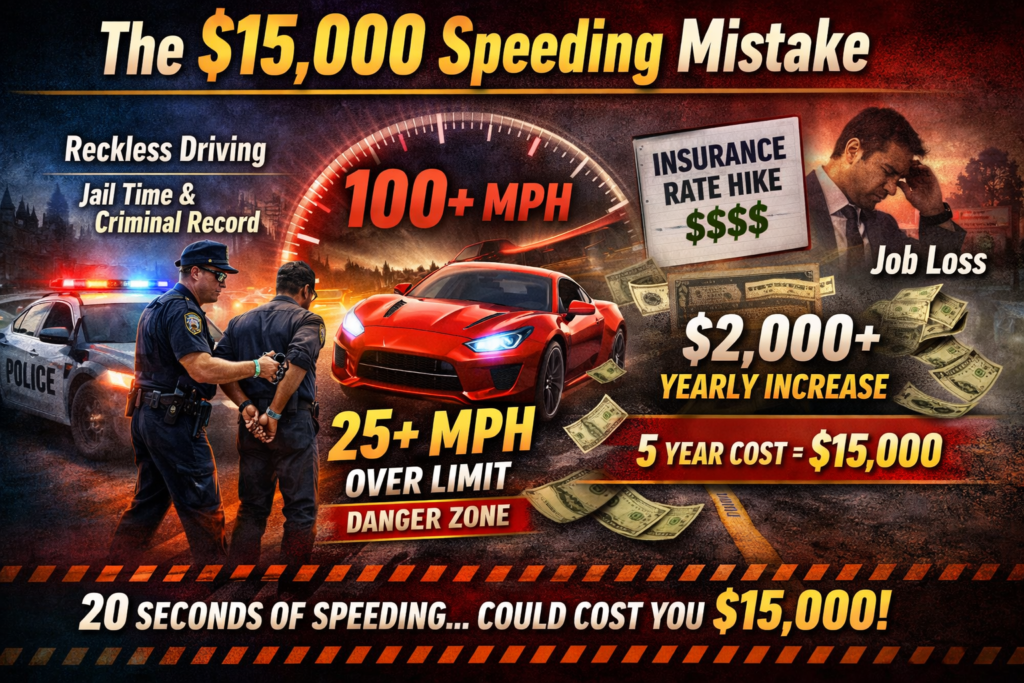
25mph over = speeding ticket you pay online. 30mph over = CRIMINAL record that kills jobs.
Texas drivers get screwed daily. Same highway, same cop, same traffic stop. One officer writes “speeding” ($250 fine, insurance bump). The other writes “RECKLESS” (30 days jail, $2K fine, background check disaster).
You won’t even know which one you’re facing until the court date hits.
Cops don’t post “cutoff speed” signs. Heavy rain? 25mph over = reckless. Empty highway? 30mph over = just speeding. School zone? 20mph over = criminal. Your attitude, the weather, traffic density—they ALL count.
Most guys learn this the hard way:
- Job interview tanks (misdemeanor shows up)
- Insurance doubles ($3K/year)
- License hangs by a thread
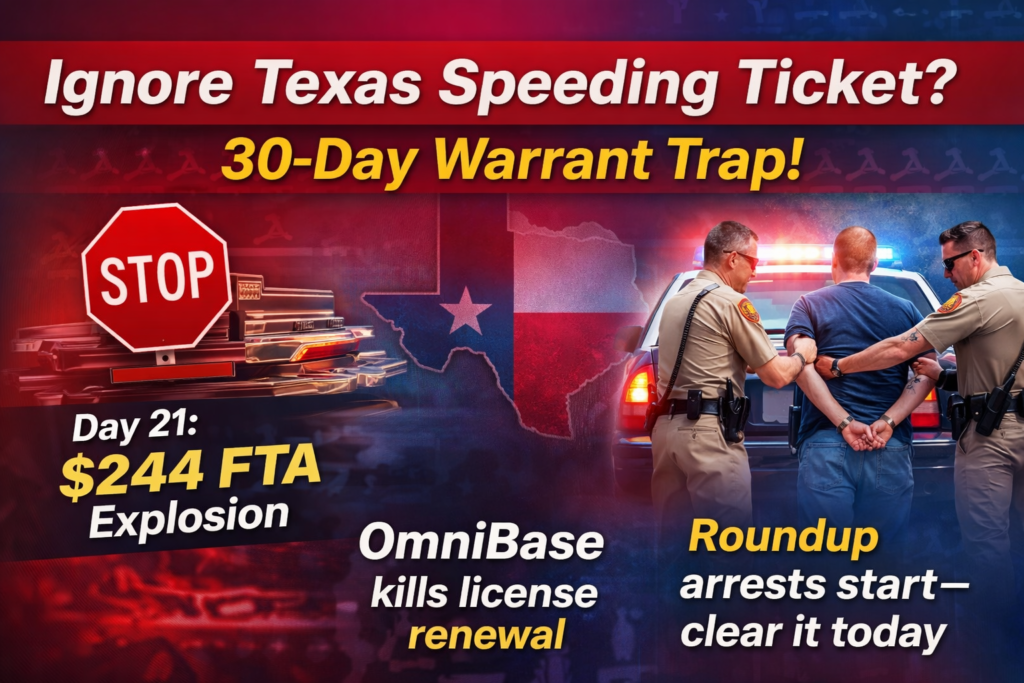
- Skip court date = arrest warrant ($75 extra fee in 2026)
This Texas roadmap tells you EXACTLY: ✅ Where cops draw the reckless line ✅ Real fines vs. jail scenarios ✅ How to fight/dismiss before it kills you ✅ The insurance escape plan
No $500 lawyer hour. No 50-page PDF. Just the Texas numbers that save your record.

What Is a Speeding Ticket in Texas?
A speeding ticket in Texas is a civil traffic violation. That means it’s not a crime. You’re not going to jail for a basic speeding ticket, and it won’t show up on a criminal background check. But don’t take that as a reason to ignore it — the costs and consequences add up fast.
How Texas Speeding Fines Work
Texas uses a tiered fine system. The faster you go over the posted speed limit, the bigger the fine. Here’s a general breakdown of speeding ticket Texas fines:
- 1 to 10 mph over the limit: Around $150 to $200 in most counties
- 11 to 15 mph over the limit: Around $200 to $250
- 16 to 20 mph over the limit: Around $250 to $300
- 21 to 25 mph over the limit: $300 or more
- More than 25 mph over the limit: Higher fines — and this is where reckless driving starts coming into the picture
Keep in mind that fines vary by county and city. The base fine is set by Texas state law, but courts stack on fees and court costs that can push the total well past $400 in some areas. That $150 ticket? Don’t be shocked when the final bill says $380.
Points on Your Texas Driver’s License
Texas tracks violations through a point system. While the old ‘Surcharge’ program has been repealed, accumulating too many points still leads to automatic license suspension and high-risk insurance categories.
Texas driver license points for speeding can feel minor at first. But two or three tickets over a few years and suddenly you’re paying hundreds of dollars a year in surcharges on top of everything else.
Key point: A speeding ticket is a civil offense. Reckless driving is a criminal offense. That one difference changes everything else that follows.
What Is Reckless Driving in Texas?
This is where things get serious. Reckless driving in Texas is not a traffic ticket — it’s a criminal charge. Under Texas Transportation Code Section 545.401, reckless driving means operating a vehicle with willful or wanton disregard for the safety of people or property.
That phrase — willful disregard driving Texas — is the part that really matters. The law isn’t talking about someone who accidentally misjudged their speed. It’s talking about someone who knew their driving was dangerous and did it anyway. That’s a different thing entirely, and Texas courts treat it that way.

What Does Reckless Driving Look Like in Texas?
Reckless driving charges can come from a wide range of situations. Some of the most common include:
- Driving at a very high speed — especially 20 mph or more over the posted limit
- Cutting aggressively through heavy traffic
- Running multiple red lights or stop signs back to back
- Street racing or drag racing on public roads
- Tailgating at high speeds on the highway
- Passing on blind curves or over hills where visibility is limited
- Driving fast near schools, playgrounds, or active construction zones
Here’s something a lot of drivers don’t realize: going 20 miles over the speed limit in Texas does not automatically mean a reckless driving charge. But it can absolutely be used to support one. If an officer decides your speed — combined with everything else happening around you — showed a clear disregard for safety, they can charge you with reckless driving instead of, or on top of, a speeding ticket.
Reckless Driving vs Speeding Texas: Where the Line Is
The real difference in reckless driving vs speeding Texas cases comes down to intent and situation. A speeding ticket says you broke the speed limit. A reckless driving charge says you made a choice to drive in a way that put people at risk. That’s a different accusation with different consequences.
The Penalties — How Big Is the Gap?
Most people don’t realize how far apart these two charges really are until they see it laid out side by side. Here’s the full picture.
Under House Bill 2282 (2026), if a ticket turns into a warrant, a mandatory $75 warrant reimbursement fee is added to your total costs.
Quick Comparison: Speeding Ticket vs Reckless Driving in Texas
| Factor | Speeding Ticket | Reckless Driving |
| Type of Offense | Civil traffic violation | Class B misdemeanor (criminal) |
| Criminal Record? | No | Yes — permanent criminal record |
| Jail Time? | No | Up to 180 days in county jail |
| Fine Amount | $1 – $200+ depending on speed | Up to $2,000 |
| License Points | 2–3 points added to record | Possible suspension or revocation |
| Insurance Impact | Moderate rate increase | Severe rate increase or cancellation |
| Court Required? | Optional in most cases | Mandatory court appearance |
| Attorney Needed? | Recommended | Strongly recommended |
Speeding Ticket Texas Fines — The Real Numbers
The base fine for a speeding ticket in Texas starts low — technically as little as $1 — but by the time the state adds court costs and administrative fees, most drivers end up paying somewhere between $150 and $500. School zones and construction zones push those numbers higher. It hurts your wallet, but it’s a one-time hit you can recover from.
Texas Reckless Driving Penalties
Now here’s where it gets much more serious. Texas reckless driving penalties include:
- • A fine of up to $200 for a first offense — but that’s just the starting point
- Maximum penalties for Reckless Driving in Texas: Jail up to 30 days and a fine of up to $200.
- • Up to $500 in fines for a second offense
- • Up to 90 days in jail for a second offense
- • Court costs and fees that can push the total financial hit into the thousands
- • A permanent criminal record that follows you for years
That last point is the one that catches people off guard. Reckless driving in Texas is a Class B misdemeanor. That means it’s a criminal offense. It goes on your permanent criminal record. It shows up on background checks. Employers see it. Landlords see it. Licensing boards see it.
A Class B misdemeanor in Texas carries a maximum of 180 days in county jail and a fine of up to $2,000. Misdemeanor reckless driving jail time is not just a technicality — it’s a real outcome in Texas courts.
What a Class B Misdemeanor Really Means
A lot of drivers hear ‘reckless driving’ and think it’s just a serious traffic ticket. It’s not. It’s a Class B misdemeanor — a criminal charge — and understanding what that means is important.

How Texas Classifies Criminal Offenses
Texas divides criminal offenses into felonies and misdemeanors. Within misdemeanors, there are three levels: Class A (most serious), Class B, and Class C (least serious). A basic speeding ticket is a Class C. Reckless driving is a Class B — one step up, and that step matters.
Here are the maximum penalties for a Class B misdemeanor in Texas:
- Jail: Up to 180 days in county jail
- Fine: Up to $2,000
- Probation in some cases
- Permanent criminal record
So when someone faces a class b misdemeanor for driving reckless, they’re not just dealing with a ticket. They’re potentially facing jail time, a criminal conviction on their record, and long-term effects on their career and life. That’s why taking this charge seriously — and getting a lawyer — isn’t optional.
How a Reckless Driving Conviction Follows You
Beyond the fines and possible jail time, a reckless driving conviction creates problems that many drivers don’t see coming:
- Jobs: Background checks are standard in most industries. A Class B misdemeanor can rule you out for jobs in transportation, government, healthcare, or education.
- Professional licenses: Nurses, teachers, lawyers, real estate agents — many licensed professions require you to disclose criminal convictions. A reckless driving charge can trigger a board review.
- Car insurance: Your rates will go up — sometimes a lot. In some cases, your insurer will drop you entirely. This effect can stick around for 3 to 7 years.
- Renting a home: Landlords run background checks too. A misdemeanor conviction can make it harder to get approved.
- Immigration status: If you’re not a US citizen, a criminal misdemeanor conviction can have serious immigration consequences. Talk to an immigration attorney right away.
When Does Speeding Turn Into Reckless Driving?
This is probably the most common question Texas drivers have after getting pulled over: at what point does going too fast become a reckless driving charge? The honest answer is that there’s no single speed written into Texas law that automatically triggers it. It depends on what was happening around you.

Speed and Reckless Driving — How Officers Think About It
While no specific speed is the legal cutoff, here’s how courts and officers generally look at it in practice:
- 1 to 10 mph over: Almost always just a speeding ticket
- 11 to 20 mph over: Speeding ticket territory, though other factors still matter
- 20 mph or more over: Risk of a reckless driving charge goes up, especially with other unsafe behavior
- 30 mph or more over: Very likely to result in an excessive speeding reckless charge
- Street racing or extreme speeds: Reckless driving is almost certain
The 20 miles over speed limit Texas scenario is genuinely a gray area. An officer who pulls you over doing 85 in a 65 on an empty highway with dry roads might write you a standard speeding ticket. That same speed in bumper-to-bumper traffic, in a school zone, or during a rainstorm? That same officer now has solid grounds for a reckless driving charge.
What Makes a Speeding Situation More Dangerous in Texas Eyes
Speed alone isn’t always enough for a reckless charge. But combine it with any of these, and the risk goes up fast:
- Bad weather — rain, fog, ice, strong wind make high speeds far more dangerous
- Heavy traffic — passing through cars at high speed shows clear disregard for others
- High-risk zones — school zones, hospital areas, residential streets, construction zones
- Time of day — high speeds in areas with foot traffic or kids around
- What you were doing at the time — aggressive lane changes, running lights, tailgating
The officer’s read on the situation plays a big role. If they believe your driving showed willful disregard for the safety of others, they can charge you with reckless driving — even if your exact speed alone would normally only get a ticket.
Texas Traffic Violations — The Full Picture
To really get why the gap between a speeding ticket and reckless driving is so big, it helps to see how Texas organizes traffic violations overall. Not all moving violations are treated the same.
Class C Misdemeanor Traffic Violations
Most standard traffic violations in Texas — speeding, running a red light, failing to signal — are Class C misdemeanors. They carry fines up to $500, no jail time, and while they go on your driving record, they don’t leave a criminal conviction the way a Class B does. A regular speeding ticket lives here.
Class B Misdemeanor Traffic Violations
This is where reckless driving sits. Criminal charges, real consequences. This tier also includes things like:
- Reckless driving (Texas Transportation Code Section 545.401)
- Leaving the scene of a minor accident
- Drag racing in certain circumstances
Class A Misdemeanor and Felony Traffic Violations
The most serious traffic offenses go even higher. A first DWI in Texas is typically a Class B misdemeanor, but repeat offenses or aggravating factors push it to Class A or even a felony. Vehicular manslaughter is a felony. These are the most extreme traffic ticket vs criminal Texas situations you can face.
Understanding where your specific situation falls on this scale is what determines the real danger you’re in. Dangerous driving Texas penalties increase sharply at each level.
What Happens in Court
Dealing With a Speeding Ticket in Texas
For most speeding tickets, you have a few options:
- Pay the fine and accept the points
- Fight the ticket in traffic court — you have every right to do that
- Take a defensive driving course to get the ticket dismissed (if you’re eligible)
- Request deferred adjudication to keep it off your record
A lot of Texans just pay the fine and move on. That’s understandable, but worth thinking twice about — especially if the ticket would push you over the points limit or spike your insurance. You have more options than most people use.
Fighting a Reckless Driving Charge in Texas
A reckless driving charge is a different situation entirely. Because it’s a criminal charge — a class b misdemeanor — you need to treat it like one. That means:
- You have the right to a jury trial
- The prosecution has to prove willful or wanton disregard beyond a reasonable doubt
- A lawyer can challenge the officer’s account and conclusions
- Dashcam footage, GPS records, traffic cameras, and witness statements can all help your case
- A plea deal may be on the table — and often, reckless driving can be negotiated down to a speeding ticket
That last point is worth repeating. One of the most common approaches in Texas reckless driving cases is getting the prosecutor to reduce the charge to a standard speeding violation. That single move removes the criminal conviction, cuts out any chance of jail time, and saves you thousands in long-term insurance costs. A traffic attorney who knows the local courts can often make that happen.
Don’t just plead guilty to a reckless driving charge without at least talking to a lawyer first. The consequences are too serious to handle without knowing all your options.
What This Does to Your Insurance
People tend to focus on the ticket fine when they get pulled over. But the insurance hit — especially after reckless driving — can cost you far more money over time than the ticket itself ever would.

Insurance After a Speeding Ticket
A standard speeding ticket in Texas will push your insurance rates up. How much depends on your insurer, your history, and how fast you were going. One speeding ticket usually raises rates by roughly 20 to 30 percent for a few years. Go far enough over the limit and that number climbs higher.
Insurance After Reckless Driving
Reckless driving is treated as a major violation by insurance companies — and the financial hit reflects that. Here’s what tends to happen:
- Rate increases of 50 to 100 percent or more are common after a reckless driving conviction
- Some insurers will drop you entirely rather than keep you on
- You may end up in the high-risk insurance market, requiring SR-22 coverage
- The rate damage usually sticks around for 5 to 7 years
Put real numbers on it: if you were paying $1,500 a year for car insurance, a reckless driving conviction could push that to $2,500 or $3,000 a year — or more. Over five years, that’s an extra $5,000 to $7,500 coming out of your pocket. And that’s on top of the fines, the court costs, and whatever you paid a lawyer.
Your Texas Driver’s License — Points, Suspension, Revocation
Both charges affect your license, but in very different ways. Here’s how each one plays out.
Speeding Ticket Points in Texas
The Texas Driver Responsibility Program tracks violations like this:
- Standard moving violation (speeding): 2 points
- Moving violation that caused an accident: 3 points
- 6 or more points in 3 years: Annual surcharge of $100 for the first 6 points, then $25 for each point after that
- Too many violations over time: Risk of license suspension
Reckless Driving and Your License
A reckless driving conviction in Texas doesn’t automatically pull your license. But there are real ways it can get there:
- The conviction adds points to your record, which can push you into surcharge territory fast
- A judge can choose to suspend your license as part of the sentence
- Multiple reckless driving convictions put you at serious risk of revocation
- If the charge is bundled with something like a DWI, the license consequences get much worse
On top of that, the Driver Responsibility Program means racking up too many serious violations — even without a formal suspension order — can get your license suspended through the surcharge system if you don’t pay up. Ignore those surcharges and the state will take your license.
Real-World Scenarios — Which Charge Are You Facing?
Let’s look at how Texas officers typically handle different speeding situations in 2026. This will help you understand where your specific case might land.
Scenario 1: The “Standard” Speeding (10 MPH Over)
- Situation: You’re doing 75 in a 65 on a clear highway.
- Result: This is almost always a Civil Speeding Ticket. In 2026, you can usually handle this online, pay the fine, or take a safety course to keep it off your record. No jail, no criminal record.
Scenario 2: The “Danger Zone” (25 MPH Over)
- Situation: You’re caught doing 90 in a 65 MPH zone.
- Result: You are now Ineligible for a Driving Safety Course. While this is still often written as a speeding ticket, it’s a “permanent” one. It will go straight to your driving record, and your insurance company will see it as a major risk.
Scenario 3: The “Reckless Driving” Threshold (30+ MPH Over)
- Situation: You’re doing 100+ MPH on the interstate or 30 MPH over the limit in heavy traffic.
- Result: This is a strong setup for a Class B Misdemeanor (Criminal Offense). In 2026, many Texas departments use the 30-over mark as automatic grounds for a Reckless Driving charge. You are looking at a permanent criminal record and a mandatory court appearance.
Scenario 4: High-Risk Zones (School & Construction)
- Situation: You’re doing 40 in a 20 MPH school zone while kids are present.
- Result: Even though you are “only” 20 over, the location makes this Criminal Negligence. In 2026, zero-tolerance policies mean you will likely face a Reckless Driving charge, double fines, and a high risk of license suspension.
Can a Reckless Driving Charge Be Knocked Down?
After being charged with reckless driving in Texas, a lot of people ask the same thing: can this be reduced to a speeding ticket? In many cases, yes — but it takes the right legal help and the right approach.
Texas prosecutors have the power to offer plea deals. A good traffic attorney can often get a reckless driving charge reduced to a Class C misdemeanor — a standard speeding ticket. That difference is massive:
- No criminal conviction on your record
- No risk of jail time
- Much smaller hit to your insurance
- No long-term misdemeanor on your background
The earlier you move on this, the better. An attorney who has worked in your specific Texas county — who knows the prosecutors and the judges — is worth every penny when a Class B misdemeanor is on the table.
This is not legal advice — every case is different. But as a general rule: treat a reckless driving charge the same way you’d treat any other criminal matter. Because legally, that’s exactly what it is.
What to Do After Getting a Ticket or Charge
If You Got a Speeding Ticket
Don’t just pay it without thinking it through first. Here’s what to consider:
- Check if you’re eligible for a defensive driving course to get the ticket dismissed
- Look into deferred adjudication if keeping it off your record is a priority
- If the ticket has errors or the circumstances seem off, contest it
- Talk to a traffic attorney if this ticket would push you over the points limit or hit your insurance hard
If You Got a Reckless Driving Charge
This one needs faster, more serious attention:
- Do not plead guilty or pay anything before you speak with a lawyer
- Find a Texas traffic attorney with real experience in criminal misdemeanor cases
- Pull together any evidence that could help — dashcam footage, GPS data, any witnesses who saw what happened
- Show up to every required court date — missing one can make your situation much worse
- Ask your attorney about getting the charge reduced to a standard speeding violation
Conclusion: Know the Difference — It Could Change Your Life
Here’s the bottom line on Texas speeding ticket vs reckless driving: one is a fine, the other is a criminal charge. One you pay and forget. The other follows you.
A speeding ticket in Texas is a headache. Speeding ticket Texas fines hurt your wallet, the points hurt your license, and your insurance goes up for a while. But it’s manageable. It’s temporary.
A reckless driving conviction is something else. Texas reckless driving penalties include a Class B misdemeanor on your permanent criminal record, possible jail time, and insurance damage that can last for years. It can affect where you work, where you live, and whether you can keep the professional licenses you’ve spent years building.
If you’ve got a speeding ticket, handle it smart — know your options before you just pay it. If you’re facing a reckless driving charge, get a lawyer and take it seriously from day one. Don’t assume it’ll go away on its own, because it won’t.
Texas roads are busy, Texas law enforcement is active, and Texas courts don’t take dangerous driving lightly. Know what you’re dealing with. Know your rights. And if you’re in trouble, get the right help.
Frequently Asked Questions
No. Reckless driving in Texas is a Class B misdemeanor, not a felony. But if the reckless driving caused serious injury or death, the charges can move up to a felony under other Texas statutes.
Reckless driving adds points to your driving record and is treated as a serious moving violation. Beyond the points though, the criminal conviction itself is what does the most damage — on background checks, with employers, and with your insurance company
No. A speeding ticket is a civil violation. Jail time isn’t on the table for a basic speeding ticket. However, if you skip your court date or don’t pay your fines, you can be arrested for failure to appear — not for speeding itself.
Not automatically. Going 20 miles over the speed limit in Texas doesn’t guarantee a reckless driving charge, but the risk goes up a lot — especially when there are other unsafe factors in play like bad weather, heavy traffic, or a high-risk area like a school zone
On your Texas driving record, it typically stays for several years. But as a Class B misdemeanor, it stays on your criminal record permanently — unless you go through the expungement process and qualify to have it cleared.
They’re related but not the same thing. Aggressive driving usually means a pattern of multiple moving violations that, together, put others in danger. Reckless driving focuses on a single episode of driving with willful disregard for safety. Both are serious charges, but they’re handled differently under Texas law.
Disclaimer: This article is provided for general informational and educational purposes only and does not constitute official legal advice. While we strive to provide accurate updates for 2026, Texas traffic laws are subject to change. Accessing or reading this content does not create an attorney-client relationship. If you are facing a criminal charge or a traffic violation in Texas, please consult with a licensed attorney to discuss the specifics of your case.