
Getting a speeding ticket in the Lone Star State is more than just a legal annoyance—it’s a targeted hit to your bank account. Many drivers make the mistake of just “paying the fine” to get it over with, not realizing that doing so is a formal admission of guilt that stays on your record for years. By 2026, the average cost of a speeding ticket in Texas has risen significantly, with construction zones and school zones now carrying penalties that can reach as high as $600.
Understanding the cost of a speeding ticket in Texas means looking past the base fine. You have to consider the “hidden” state surcharges and the long-term impact on your driving history. If you’re currently staring at a citation from Harris County or Dallas, you need to know the specific Texas speeding ticket fines for your area. We’ve done the research to help you navigate the 2026 fine schedules, identify speed traps, and find ways to lower the total cost before your deadline hits.
The Anatomy of a Texas Speeding Ticket Cost
When you are holding that yellow slip of paper in your hand, the amount you read is not the fine, it is a bundle of a variety of charges. In 2026, the Texas speeding ticket cost was broken down into three main parts: the base fine, court costs, and state consolidated fees.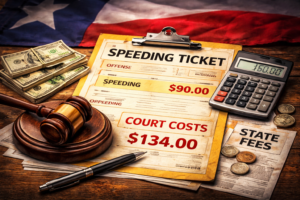
The “Base Fine” vs. Total Cost
The base fine is the amount set by the city or county for the actual act of speeding. For example, if you are going 10 mph over the limit, the base fine might only be $45 to $100. However, Texas law requires every municipal and JP court to add “Court Costs” to every single ticket. These costs cover everything from courthouse security to state-wide traffic safety funds.
By the time these fees are added, a “small” $50 fine often balloons into a $220 total payment. This is why many drivers feel blindsided; they expect a small penalty but end up paying more than double what they anticipated.
The MPH Breakdown: How Much is 10, 15, or 25 Over?
Texas uses a tiered system for speeding. Generally, the faster you go, the more you pay per mile. While every county has slightly different rates, here is the general Texas speeding ticket cost breakdown you can expect in 2026 for standard moving violations:
2026 Tiered Fine Estimates
- 1 to 5 MPH Over: You are looking at a total cost of roughly $165 to $180. Most officers won’t pull you over for this, but in strict “speed trap” towns, it happens.
- 6 to 10 MPH Over: This is the most common ticket range, usually costing between $195 and $225.
- 11 to 15 MPH Over: Costs jump here to about $240 to $260. Texas is one of the few states where a 15-mph violation almost always exceeds the $200 mark.
- 16 to 24 MPH Over: Now you are entering the “Expensive Zone,” with costs ranging from $280 to $350.
- 25+ MPH Over: If you are caught going 25 mph or more over the limit, the Texas speeding ticket cost often hits the $500 maximum. At this speed, you may lose the option to take defensive driving, and some judges might even require a mandatory court appearance.
The “Court Costs” Trap (Hidden Fees)
If you are trying to calculate your Texas speeding ticket cost at home, you have to account for the “Consolidated Court Fees.” In 2026, these fees are non-negotiable and are applied to every moving violation in the state.
Why the bill is so high
On average, court costs in Texas range from $134 to $160 per ticket. Even if the judge decides to lower your base fine to $1, you still have to pay the $134 in court costs. These fees are distributed to various state programs, including:
- The State Jury Fund
- Judicial Support Fees
- Indigent Defense Funds
- Crime Stoppers
This is the “hidden trap” of the Texas legal system. A clerk, when you tell them, “How much is my ticket? they will give you the total. However, when you look at the receipt, you will realize that the administrative fees the state charges to handle the paperwork, is, in fact, smaller than the fine. This breakdown is crucial to be understood since it makes it clear why it is never so cheap to pay the fine.
School Zones & Construction Zones (The Double Fine Rule)
If there is one thing that can instantly wreck your monthly budget, it’s getting caught speeding in a restricted zone. In 2026, Texas doubled down on its commitment to safety in areas where workers or children are present. The Texas speeding ticket cost for these violations is intentionally designed to be painful.
The Construction Zone “Worker Present” Rule
Under the Texas Transportation Code, fines are automatically doubled if you are speeding in a construction or maintenance work zone while workers are present. This is no mere suggestion but a legal multiplier which is compulsory. Assuming a typical ticket in such a county would cost 200 you are at least paying 400 not counting court costs.
School Zone Penalties
School zones are just as strict. Because of the high risk to pedestrians, the base fines in school zones are significantly higher than on the open highway. In 2026, most Texas cities add a dedicated “School Zone Surcharge” of at least $25 to $50 on top of the already inflated fine.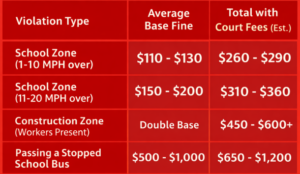
City vs. City: Houston, Dallas, El Paso & More
One of the most frustrating parts of driving in Texas is that the Texas speeding ticket cost changes the moment you cross city or county lines. There is no “state-wide price” for speeding. Each municipal court sets its own schedule based on local ordinances.
The Big City Comparison (2026 Data)
In 2026, major hubs like Houston and Dallas remain the most expensive places to get a ticket due to high administrative overhead. Meanwhile, smaller cities like Plano have very specific, tiered charts that can catch drivers by surprise.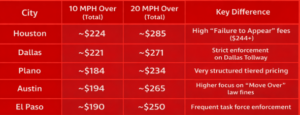
Texas Highway Patrol (DPS) Tickets on I-35 & I-10
If you are pulled over by a Texas State Trooper (Highway Patrol) while traveling between cities, your experience will be slightly different. These tickets are usually handled by Justice of the Peace (JP) Courts rather than city municipal courts.
Why JP Courts Matter
Because JP courts handle tickets for entire counties, their Texas speeding ticket cost schedules might be higher than the city next door. For example, a ticket from a Trooper in Johnson County might cost you $20 more in court fees than a ticket from a city officer in nearby Cleburne.
State Troopers also have a reputation for “no-nonsense” ticketing. While a city officer might give you a warning for 7 mph over, a Trooper patrolling I-10 or I-35 is much more likely to write a citation for the exact speed clocked. In 2026, DPS tickets also feed directly into the state’s database, meaning your insurance company will likely see the conviction faster than a ticket handled in a small municipal court.
Small Towns & Speed Traps (Abilene, Killeen, and Beyond)
If you’re driving through the wide-open spaces of West Texas or the corridors near military bases like Fort Cavazos, you need to stay alert. Small towns in Texas are notorious for “speed traps”—areas where the speed limit drops abruptly, and enforcement is extremely tight. In these jurisdictions, the Texas speeding ticket cost is often a major source of local revenue.
Why Small Town Tickets Cost More
In cities like Abilene or Killeen, the municipal courts may not have the massive volume of a city like Houston, but their administrative fees are just as high. Furthermore, small-town judges are often less likely to offer leniency for high-speed violations. If you are caught doing 10 mph over in a small town, you might find that the “local consolidated fee” pushes your total bill well over the $230 mark.
H3: Common Speed Trap Areas in 2026:
- I-20 near Abilene: Frequent DPS patrols and local deputies monitor the transitions between 75 mph and 65 mph zones.
- Hwy 190 near Killeen: High enforcement near the base to ensure safety for commuting service members.
- Small Webb County Towns: Along the route to Laredo, towns like Encinal are known for strictly enforcing even minor speeding infractions.
The Speeding Ticket Cost Calculator (The Math)
Most drivers want a simple way to estimate their bill before the court letter arrives. While every court is different, Texas generally follows a “Base + Per Mile” formula. In 2026, you can use this simple logic to estimate your Texas speeding ticket cost.
The Standard 2026 Formula
Total Cost = [Base Fine] + [Court Costs] + [Per Mile Charge]
To give you a better idea of the math, look at this breakdown based on the average 2026 rates for a standard (non-school zone) ticket:
| Component | Average Estimated Amount |
| State Consolidated Court Fee | $134.00 (Mandatory) |
| Local Municipal Fee | $15.00 – $30.00 |
| Base Fine (1st Mile Over) | $41.00 |
| Additional Mile Charge | $5.00 to $10.00 per mile |
Example Calculation: If you are caught doing 12 MPH over the limit:
- $134 (Court Fees) + $41 (Base) + $60 ($5 x 12 miles) = $235 Total.
Hidden Costs: Insurance & Driver Points
The number on your ticket is just the beginning. The “real” Texas speeding ticket cost hits you every month for the next three years through your auto insurance premiums. In 2026, Texas remains a “Conviction-Based” state, meaning insurance companies monitor your record closely.
The 20-25% Insurance Spike
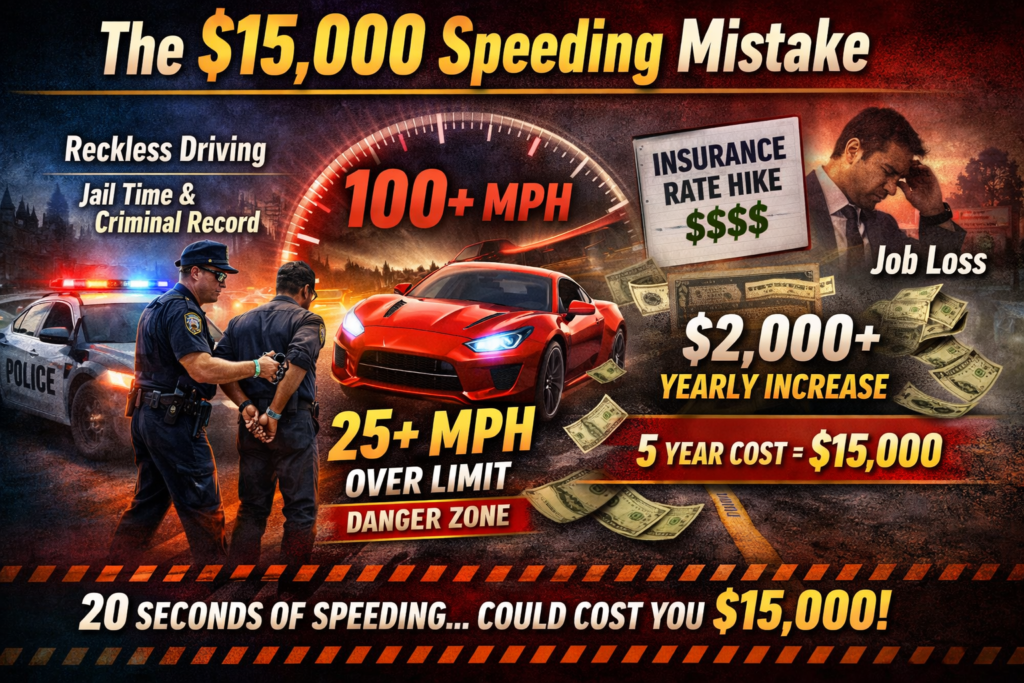
Once a speeding ticket becomes a permanent conviction on your record, you are flagged as a “high-risk” driver. On average, a single speeding ticket in Texas will raise your insurance rates by 20% to 25%.
If you currently pay $1,800 a year for full coverage, that single ticket could cost you an extra $450 per year. Since tickets typically stay on your insurance rating for three years, your $235 ticket just turned into a $1,585 total loss.
Driver Record Impacts
While Texas officially abolished its “Driver Responsibility Program” (the old points-based surcharge system) years ago, your record still matters. If you rack up too many moving violations—specifically four in 12 months or seven in 24 months—the state can suspend your driver’s license entirely. At that point, the cost includes lawyer fees, reinstatement fees, and the massive headache of not being able to drive.
How to Lower the Cost (Dismissal Options)
If you’re worried about the long-term impact on your wallet, you’ll be glad to know that the Texas speeding ticket cost can often be mitigated if you act quickly. You aren’t always stuck with the full fine and the insurance hike. In 2026, Texas drivers have two primary “escape hatches” to keep their records clean.
1. Defensive Driving (Driving Safety Course)
This is the most common way to make a ticket disappear. Instead of paying the full fine, you pay a smaller administrative fee to the court (usually around $144).
The Deal: You agree to take a 6-hour TDLR-approved safety course. Once you submit your certificate and a copy of your Texas Type 3A Driving Record, the court dismisses the ticket. It never hits your insurance, and you might even get a discount on your premium for completing the class.
- Cost Savings: You save the “Fine” portion of the ticket (often $50–$150) and thousands in potential insurance hikes.
- Eligibility: You can’t have used this option in the last 12 months, and you can’t be a CDL holder.
2. Deferred Disposition (Probation)
Think of this as “unsupervised probation.” You pay the court a fee (usually the full amount of the fine plus a small extra charge) and agree not to get another ticket for a set period, typically 60 to 90 days.
- The Benefit: If you drive safely during that time, the ticket is dismissed. No class is required, but the upfront Texas speeding ticket cost is higher than defensive driving.
If you are ready to keep your record clean, you can dismiss your Texas speeding ticket online here through our TDLR-approved partner.
Conclusion
Navigating the Texas speeding ticket cost in 2026 requires more than just looking at the number on your citation. From the moment the officer pulls you over, the clock is ticking on your 10-day deadline to act. By understanding the breakdown of court fees, the severity of special zones, and your options for dismissal, you can turn an expensive mistake into a manageable situation.
Don’t just “pay and move on”—take the time to explore defensive driving or deferred disposition. Your driving record and your bank account will thank you.
Texas Speeding Ticket FAQs
On average, a 10 mph over ticket will cost you approximately $223. This includes a base fine of around $90 and mandatory state court costs of roughly $134.
In 2026, most drivers end up paying between $230 and $280 for standard violations. The base fine is often the smaller part of the bill; court costs and administrative fees make up the bulk of the total.
Yes, but only if workers are present. If you are caught speeding in a construction zone with workers on-site, your base fine is automatically doubled, often pushing the total cost above $500.
School zone tickets are among the most expensive. Expect to pay between $280 and $360 for a minor violation, as these zones include additional safety surcharges.
Both cities are high-cost areas. Houston averages about $224 for 10 mph over, while Dallas is very similar at $221. However, Houston is known for having higher “Failure to Appear” fees if you miss your deadline.
While there isn’t one “official” state calculator, a good rule of thumb is: $144 (Court Fees) + $40 (Base) + $5 for every mile over the limit.
This is considered a serious violation. You can expect a bill of $350 to $500, and you will likely be disqualified from taking defensive driving to dismiss the ticket.
Tickets issued by State Troopers are handled by County JP courts. Fees can vary, but expect to pay roughly $240 to $260 for 15 mph over on the highway.
The biggest hidden cost is your insurance. A single ticket can raise your rates by 20% to 25% for three years, potentially costing you an extra $1,200+ over time.
The best way is to request Defensive Driving. While you still pay court costs (around $144), you avoid the actual fine and the long-term insurance increase, saving you a massive amount of money overall.
Disclaimer: This article is provided for general informational and educational purposes only and does not constitute official legal advice. While we strive to provide accurate updates for 2026, Texas traffic laws are subject to change. Accessing or reading this content does not create an attorney-client relationship. If you are facing a criminal charge or a traffic violation in Texas, please consult with a licensed attorney to discuss the specifics of your case.